

Why do women strength train?
From self-respect to longevity and recovery from postpartum depression: your favorite Substack writers on lifting weights.

The reason any of us starts to lift weights differs from person to person, but most women are united in the belief that training transforms us by unlocking superpowers, strength, and self care. It’s the unexpected side effect of weightlifting. We came to build muscle, and ended up building self belief.
Why I Train is our series that pays homage to the daily commitments we make to our strength, and to ourselves. It’s where we give flowers to women like you and I; to the women interviewed in this week’s letter—Mikala Jamison, Liz Plosser, Anne Marie Chaker, Nadia Tuma Weldon, Lee Glandorf—all writers whose words we love and whose strength we respect.
These are women whose lives are nourished by lifting a weight, going for a walk, or running a few miles. What’s clear is that, in a world filled with inconsistency, being consistent with our routine enables us when life throws us a curveball.
This week, those women—some of our favorite writers on Substack—share their training stories with us.
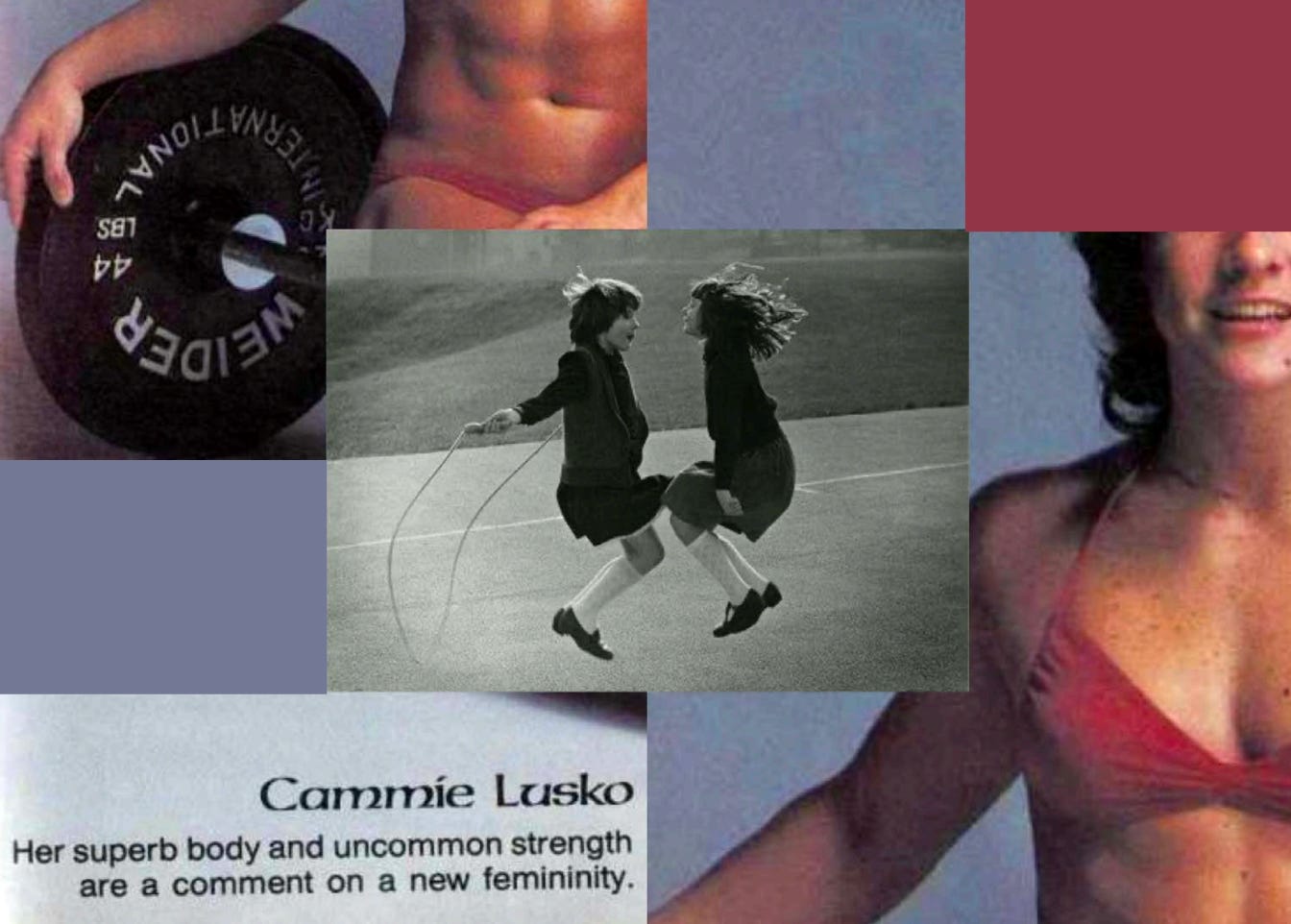
Strength training makes us feel as joyful as this.
Mikala Jamison, author of Body Type
“To be a woman who trains is to be a woman who considers herself worthy of the utmost care. In another life, my identity revolved around lack—I did not care for myself because I lacked the sense that I deserved care. I lacked self-respect, I lacked self-esteem, I lacked connection to and consideration of my physical self.
More than a decade ago, I was profoundly disconnected from my body and personal identity, which drove my disordered eating. Strength training (along with therapy) helped me connect with my sense of self again. I taught myself how to lift weights with books, Reddit threads, YouTube videos, and the help of generous friends. It shifted my identity from a woman who lacks to a woman who creates abundance for and within herself.
The resilience I have built has helped me muscle through periods of difficulty and uncertainty, like experiencing infertility, my father’s Alzheimer’s diagnosis, rocky career transitions, and other health issues. Training taught me that I can tolerate stress, tension, discomfort, and frustration and be OK on the other side.
The most memorable training session I’ve ever done was a joyful one. I pulled the heaviest deadlift of my life in a sweaty CrossFit box surrounded by gym friends who cheered for me at the top of their lungs. Only days before, I couldn’t get it off the floor.
Training has taught me that the support of others can make you not just emotionally stronger, but physically, too.”
Liz Baker Plosser, author of Best Case Scenario
“I’ve trained five days a week for about as long as I can remember, but for most of my adult life, it was all about cardio. Marathons in my twenties, triathlons and a Half-Ironman in my thirties, boutique fitness and 10Ks before work in NYC in my early forties. My brain was hardwired to believe that if I hadn’t run five miles, it wasn’t a real workout. Strength training was always there in the background, but haphazardly not strategically, and definitely not heavy.
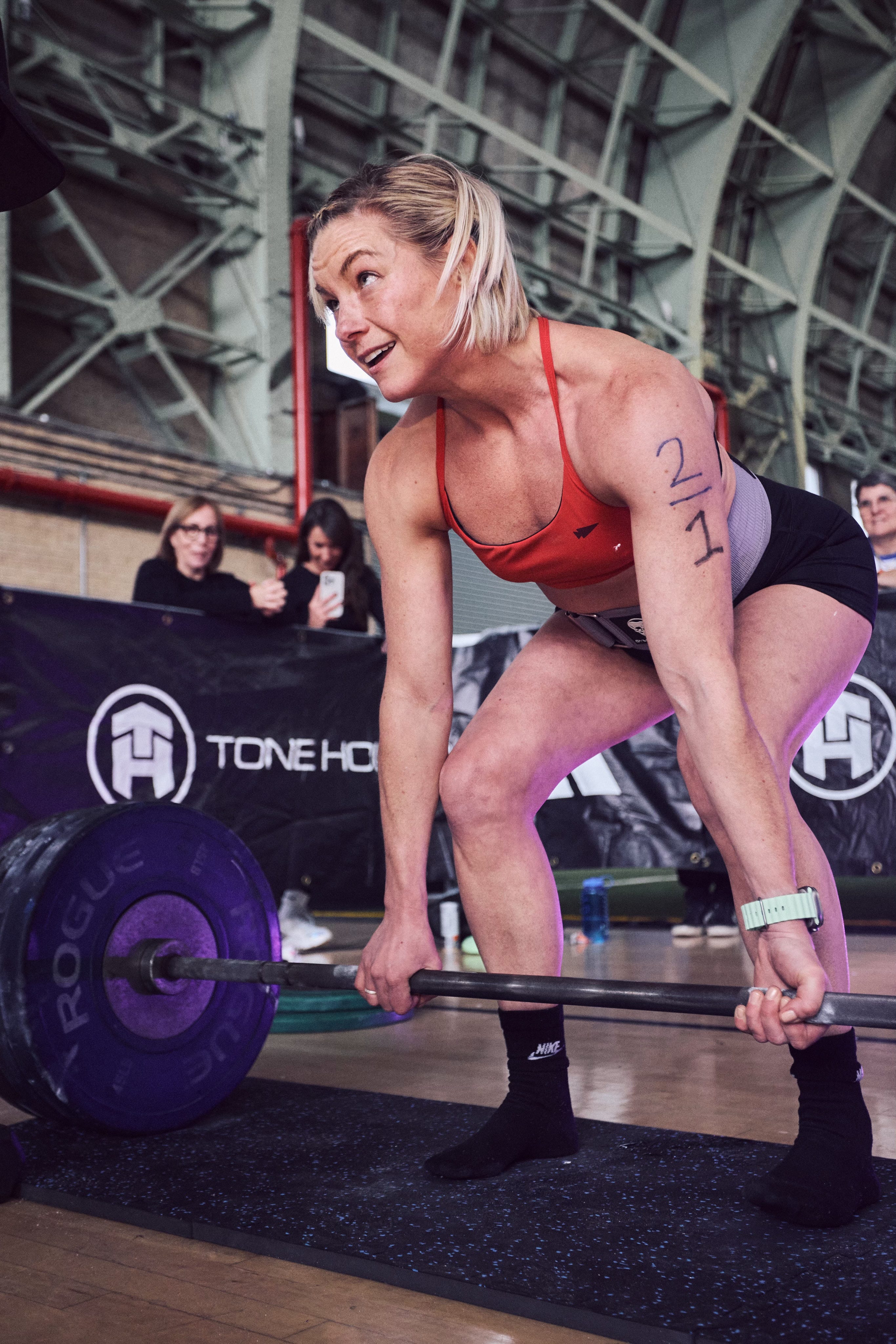
Liz, who recently competed in her first Hyrox.
Then I broke my sacrum skiing and couldn’t run for six months. At the time, it felt like a catastrophe. It turned out to be the best thing that ever happened to my training. (And my mental and emotional health.) With running off the table, I finally learned to lift like I meant it—weight that pushed me out of my comfort zone, with real intention instead of vibes. And it clicked. I found the high I’d chased on the road for two decades, except now my body responded with energy, power, and confidence.
At 43, after three kids, I saw my ab muscles for the first time in my life. I taught myself kettlebells, pull-ups and deadlifts—they’re all still my favorite things on earth. I’m not a big person, but I can pull 280 pounds off the floor, and I am not above flexing in the mirror about it.
But the real reason I train is that everything I learn at the gym applies to life: consistency, eking out one more rep when I don’t think I can, knowing when to pull back. Those are the same muscles that power me as a writer, a mom, a leader. I train early so that by the time the day’s twists and turns hit, I’ve already reminded myself I can do hard things—with my two sons and my daughter watching their mom get stronger inside and out. I love that I’m showing them that a woman can be both nurturing and gritty.”
Anne Marie Chaker, author of Lift
What does it mean to you to be a woman who trains?
To me, training is an act of self-respect. It’s one of the few places in life where effort and honesty matter more than appearance or achievement.
How has strength training altered your sense of identity?
For much of my life, I identified with what I did. I was a Wall Street Journal reporter for nearly three decades. My identity was rooted in professional achievement. Training shifted that. It gave me an identity that no job title could. I now think of myself as someone who does hard things. I don’t think of myself as someone who lifts weights.
That mindset has spilled into every corner of my life, from leaving a career I’d built over 27 years to writing a book, starting a company, hosting a radio show, and stepping onto a bodybuilding stage in my 50s. Muscle became proof that we’re never finished becoming ourselves.
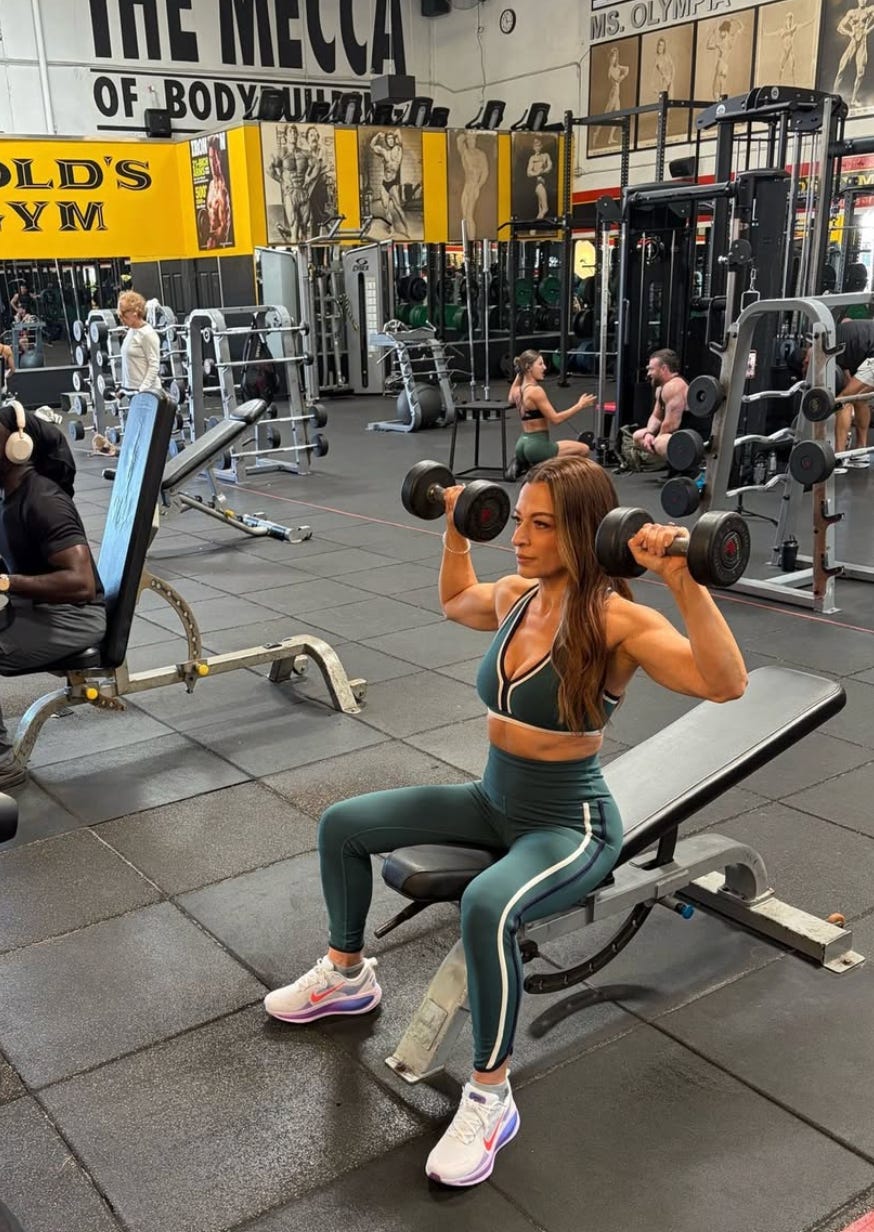
Anne Marie, training in the famous Gold’s Gym in LA.
How did it come to be such a fundamental part of your life?
It became central in my 40s, after the birth of my daughters, a difficult divorce, postpartum depression, and the sudden death of my father. I walked into a gym looking for a workout. I found a way back to myself.
Today, training is non-negotiable. I lift four to five days a week and train for bodybuilding competitions because I love having a goal that demands discipline rather than perfection. I also walk almost every day. Those walks have become moving meditation—a place where I think, solve problems, and often find the ideas that become essays, interviews, articles or books. Training isn’t separate from my work. It’s where much of my work begins.
In what ways does training encourage you to champion yourself?
Strength training has completely changed my relationship with discomfort. You don’t become stronger by avoiding difficult things—you become stronger by meeting them, repeatedly. That lesson has made me a better journalist, a better entrepreneur, a better interviewer, and, I hope, a better mother. It gave me the courage to leave a career I’d loved, build something of my own, ask for what I’m worth, and say yes to opportunities that once felt intimidating. Every heavy lift is a reminder that I can probably carry more than I think.
Lee Glandorf, author of The Sweat Lookbook
“I think it was my college rowing coach who introduced me to the idea that there was a significant difference between training and working out. Training means you’re working towards a specific goal and ideally following a plan that supports achieving it. Working out keeps you fit.
Ultimately, the mindset never leaves you. It’s about committing to the journey of getting better—in the boat, on the roads, or in the gym—and engaging in the discipline of the process. As a woman, I suppose I’ve always been proud about taking up space while training, whether that’s in the gym or on the running track, and especially when I was pregnant. I definitely delight in surprising a man with my speed or strength.
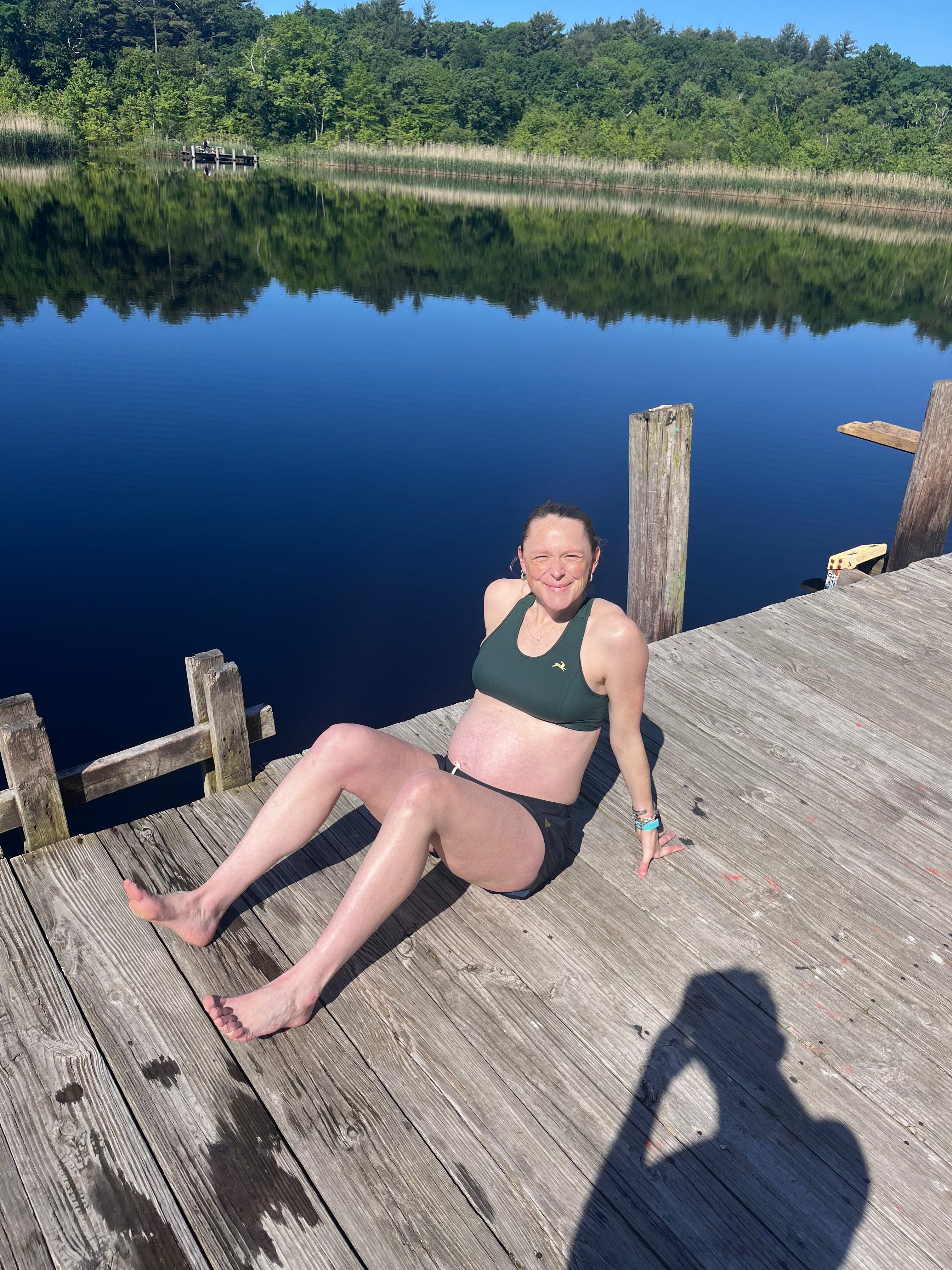
Lee, pregnant and enjoying a post-run cool down.
My biggest claim to fame is that I’m consistent. I hate having to get back into shape, so I try to keep myself at a baseline where I can run a 22-minute 5K or a 10K without stressing about it. Sometimes that competitive fire comes roaring back to life in strange ways, like when I ran a sub-8 minute mile at 39 weeks pregnant.
While I was training for the Boston Marathon, I was also trying to get pregnant, which was harder than expected. I remember doing a 10K time trial where I felt so strong. But I cried when it was over, because I was disappointed to have just gotten my period. It was hard to reconcile my body being able to do amazing things in training, but not the one thing I really wanted it to do.
I was able to get pregnant with IVF, and the delivery felt very manageable to me. 1) because I was lucky, and 2) because I could treat it like a race! I didn’t know what to expect, but I knew when push came to shove I could tap into that race day mindset to get through it. And I did!”
Nadia Tuma-Weldon, author of Nouri Paris
“I don’t train for today. I train for the woman I intend to be at age 80.
I have a very clear picture of what she looks like, because I grew up watching her. My mother started lifting weights in Beirut at fifteen and never stopped. Today, at age eighty, she plays tennis daily, lifts weights, runs, and is currently converting her garage in the Loire Valley into a gym. She is not fading, nor frail. She is formidable.
For most of my own life, my relationship with my body was entirely short-term. How much do I weigh this week? How much will I work out today? What will I eat for my next meal? Lifting weights, which I came to later, at 43, helped me reframe those questions entirely. Now I ask: what am I building, and what will it be worth in ten, twenty, thirty years?
What I discovered when I finally started lifting and seeing new tissue being built is that strength training is a longevity practice. Every session is a deposit into a future I am deliberately constructing. Because my sixties, seventies, eighties and beyond will not be decades where I am managing a slow and painful decline.
I’ve always been inspired by the Henri Matisse quote, “I hope that however old we live to be, we will die young.” I train to build up a life that is as thriving, creative and youthful for as long as possible.”
What has been the most surprising side effect of strength training for you? Let us know in the comments.
I love hearing all of these stories! The part about confidence is a huge one for me!! As a long time swimmer and yogi, I stopped lifting when I didn’t have a coach. Now, in my 30’s I haven’t felt stronger, more nourished or confident. Confidence definitely grows with age and I intend for it to. I also love hearing the moms who are showing up for themselves modeling to their children.
Nadia’s 80 year old mother is an inspiration ! My neighbor is 82 & was a long time
Skier. and she now goes to the gym, lifts weights, walks her dog multiple times a day, gets Chiro and massage, and is a serious inspiration to me!
Fun hearing these stories as I craft my own 🌀
This was such a great read. What stood out to me was how many women described training as something that changed their identity, not just their bodies. I see that all the time with my clients. They may come because they want less pain, more strength, or better mobility, but what they often leave with is trust in themselves again. To me, that's the real gift of movement. Strength isn't just about what you can lift it's about the confidence to live your life more fully.